Alright, this is new to me too, so let’s dig in. Consider this a first run at the new tax deduction in Trump’s big tax bill for 2025. I’m sure there is a lot of nuance, but this is a first whack. Proceed accordingly as we examine the new way to deduct car loan interest from taxes.
No Tax on Car Loan Interest
No tax on car loan interest is dumb. There was never any tax on car loan interest. Car loan interest is an expense, not income. So, you don’t pay tax on car loan interest already. Even if you did pay taxes on car loan interest, a deduction for that wouldn’t be “no tax” it would be less tax. So, now that we’ve dispensed with the marketing, let’s do this.
How To Deduct Car Loan Interest
Trump pumps out the headlines, congressmen write up the bills so it comes close to what Trump said. Actually, congressional staffers experienced in writing legislation write the bills, or so we hope.
In this case, no tax on car loan interest comes with some important limitations.
- A maximum deduction of $10,000
- Must be a loan for purchasing a new car
- You can deduct interest after refinancing a new car loan as long as you don’t make the loan for more than it was before.
- Loan has to be started in 2025
- It has to be a qualified vehicle.

What is a Qualified Vehicle for Deductible Car Interest?
People are always complaining about how long the tax code is. It’s not long because of the taxes. It’s long because of having to spell everything out exactly so that someone doesn’t find a loophole and exploit it. So, the short version is that it has to be a car that was assembled in the United States. That leaves a lot of wiggle room, so there are some spelled out points and definitions.
- Has to have a gross vehicle weight of less than 14,000 pounds. That’s all the normal cars, but it keeps someone from deducting some big job site truck or 18-wheeler and saying it’s “a car.”
- It has to be a personal vehicle. There’s further definition here, but the IRS can be a little bit loose here because it essentially means you have to say that it is not a business vehicle, which means you can’t deduct things like mileage or maintenance as a business expense. Slick.
- Final assembly in the US is defined for car manufactures. You don’t really have to worry about it. It says on the window sticker and title where the car was assembled. If you want, there is a VIN lookup you can use to find out if you have the VIN and not the information somehow.
Car Loan Deduction Income Limitations
One of the ways you can get the CBO to say your new tax deduction costs less (and therefore adds less to the deficit) is by limiting how long it lasts or limiting how much income you can have to get the deduction. In this case, they went with income limitations.
- Your income has to be lower than $100,000 for filing indivual
- Your income has to be lower than $200,000 for filing jointly
Important to note, the “income” in this case is your adjusted gross income or AGI. You can find it on line 11 of your Form 1040.
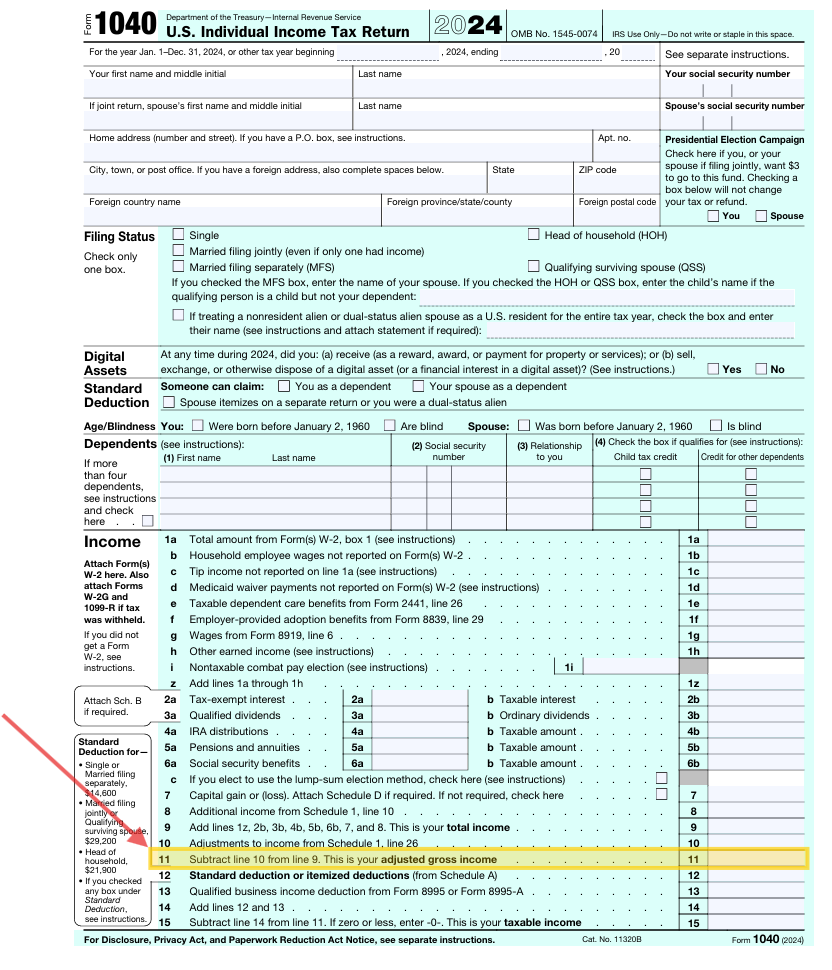
To refresh your memory, your AGI is your salary, pensions, capital gains, and business income, minus the things on Part II of Schedule 1 Adjustments to Income. You get these things even if you do not itemize your income tax deductions. So, as always, as a high-income taxpayer you want to max out the subtractions you get here. In this case, you want them to get you under $100,000 as a single filer or $200,000 as a married filing joint filer.
These subtractions are often referred to as as above the line deductions. The line, being the AGI line at 11. They occur before you take either the standard deduction or itemized deductions.
The most common deductions are HSA accounts, IRA deductions, student loan interest deductions, and self-employed deductions for retirement and health insurance contributions. (Technically your small business deductions are above the line too, but they are folded into your income from the business instead).
How Will You Know How Much Interest You Can Deduct?
Oh, goodie. Another tax form. Yep, the law requires your lender to send you a form to report the interest you pay on your car loan. No details yet, but expect it to be something like the 1098 you get from your mortgage company.
Old People!
Congress loves throwing in an extra deduction for older taxpayers. In this case, if you are 65 or older, you can claim an additional $6,000 deduction for your car interest. Each oldster can claim their own bonus, so it’s an extra $12,000 for a married couple.
The bonus deduction starts phasing out lower at $75,000 for single filers and $150,000 for joint.
What Kind of Car Is This?
Just for fun, you might wonder what it would take to max out the old car interest deduction. The important thing to remember here is that this is an “overall” deduction. You don’t get an additional deduction for more cars, but you can spread your limit out over multiple cars, which is good, because you would have to buy a $300,0000 car at 5% over 5 years to get anywhere close to the $16,000 an older married couple could deduct.
That said, a couple of $100,000 car loans (5%, 5 years) would come close to that $10,000 number.
I didn’t read enough to see if the limits are indexed to inflation, but if not, those limits are for the future not for today.
Bottom Line
To sum up, buy a car assembled in America, and deduct the interest up to $10,000 per year when you make less than $100,000 or $200,000 depending on if you are married or not.
And, if you’re wondering, it sucks compared to a flat out $7,500 CREDIT not deduction for electric vehicles. But, if you’re going to hate technology, science, and the future, this is the best you can do.
Enjoy.