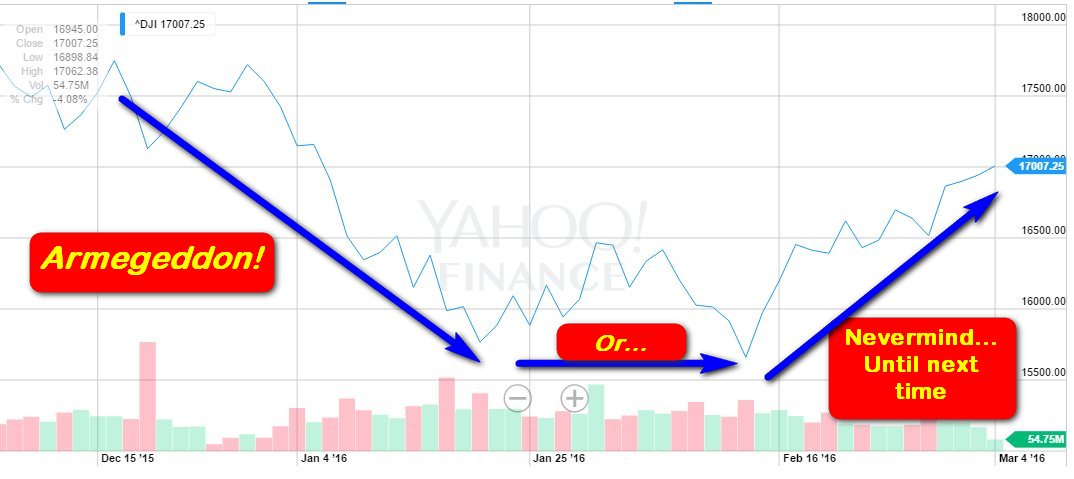
Remember when the sky was falling, China was blowing up, and the stock market was going to go straight to zero and there was going to be another super recession?
You should. It was only a couple of weeks ago.
But, as some of the calmer bloggers, (ahem) and other financial publication that don’t rely on massive waves of panicked clicks, pointed out, the stock market was actually due for a little breather after running almost straight up for a very long time. In fact, in the long run, it was probably much better for everyone (as long as they didn’t panic) for the stock market to pause for a while.
As an added bonus it made the Fed stop its blind, headlong rush into raising interest rates because that is what good hawks do, and caused them to look at the actual data instead, which suggested that while the U.S. economy is definitely moving up, the movement isn’t necessarily strong. Most importantly, there are still virtually no signs of inflation and instead, it looks like there are some weak spots hiding in the otherwise decent economy.
Stick To Your Plan
As always, the worst time to make investment decisions is during a crisis (real or otherwise). Instead, you should be developing an investment plan, whether long-term or short-term that includes the actions you will take in various instances. For a long-term plan, your only investing adjustments should be changes in your asset allocation when your risk tolerance changes. For a shorter-term plan, you should already have price targets for each stock, ETF, or mutual fund that will cause you to sell or buy, and those targets should be realistic enough to withstand some volatility, because there is almost certainly more to come.
It also seems that there are a lot more robo-advisors out there these days. I’ll be taking a look into reviewing robo-advisors soon. The upside is that they make all adjustments, just like you should, based on predetermined scenarios, usually just with some reallocation. The Acorns app offers both automatic savings, and Acorns automatic investment management. A service like WealthFront offers roboadvising for a relatively low cost. Either one allows you to set and it and forget it, so long as you schedule regular reviews of your strategies and goals.
As always, this article is for general information only and is not an offer to buy or sell securities. I am not a financial planner anymore, nor do I hold myself out to be one. If you want specific advice to your own situation, contact your tax professional or financial planning professional.