Personal Finance Index Card Advice

Back in 2013 on a show, a professor named Harold Pollack made the suggestion that everything the average person actually needed to know about personal finance could fit on an index card. He “proved” his theory by handwriting a list of personal financial advice on an index card, which then made the internet rounds. Now, he’s back with a co-author, and a $25, 256-page book called The Index Card. Wow. Could this be the most cynical book ever written?   Free Financial Advice and Reality It always seems that when finance experts are talking about OTHER finance experts, that THOSE guys are over-priced crooks who you don’t need. THEY are just out to take your hard earned money. THEY don’t want you to know that finance is actually super easy and that you don’t need THEM. Funny, how that always changes dramatically when the opportunity for money or notary for their own self comes up. Back when I was a professional financial advisor, Susie Orman would stand up in front of as many people as she possibly could and say that all financial planners and advisors were crooks and you knew it because we took money from companies that offer financial products …

Read More

China Stock Market Panic – Take 2

china crash number 2

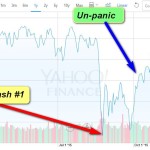
The stock market in China is in a free fall. Everyone panic! Wait. This seems familiar. Maybe, it’s because I wrote about this same thing just a few months ago during the August Chinese stock market crash. History. Learn. Repeat. Mistakes. Bad News the U.S. Economy I wrote a nice well-reasoned article recently about how you shouldn’t let bad news force you into making rash investment decisions. Here is another way to look at it courtesy of this repeat bit of stock market news. This time we have a nice little confluence of factors. There is, of course, the plunging China stock market, but this time around we have a little extra fear in the form of a nuclear test that North Korea claims is a hydrogen bomb test. (Last time, it was Middle East instability.) Well, that doesn’t sound fun? As if that weren’t enough, oil prices are falling again, and for some parts of the stock market, that’s bad. But, should we panic? George Soros isn’t helping. He’s in the news comparing today to 2008, you know when major U.S. banking institutions were failing and the Fed had to rush in to keep the whole American economy from seizing …

Read More

Money Investing and Personal Finance End of Year

end of year december finance money

Here comes the end of 2015, are you ready? Are your finances and investments ready? On the one hand, the end of the year means absolutely nothing to your money. Those twenties in your wallet don’t care what year it is, and your bank accounts don’t either. The stock market goes up and down before December 31st, just like it will after January 1st. That being said, there are some end of year tax issues to be aware of, as well as some smart money moves to make before the end of the year. What To Do With Money Before Year Ends Step One: Don’t Panic. Seriously. Too many people get all wrapped up in the end of the year and the start of a new year. I think that some of that comes from the added stress of the holidays, or the vacuum left behind when they end. The reality is that you and your money are probably fine, even if you don’t do anything at all before the year ends. Yes, tax deductions matter, but probably not as much as you might think. And, yes, there are deadlines, but many of them may not apply to you. With that …

Read More

Lower Investment Costs on ETFs

There are many different ways to successfully invest for the long-term. One such strategy is indexing. The idea of index investing is that over time very few, or maybe even none, of the various mutual funds out there, nor any portfolio you make yourself, beats the returns of the index anyways, especially after expenses. Therefore, you may as well just invest in the indexes themselves. Of course, there is no way to directly invest in an index. To do so, you basically have two choices, index funds, or index-based Exchange Traded Funds, or ETFs. (Theoretically, with enough time and money, you could create your own portfolio to mimic an index, but this is often impractical.) When doing index investing, it is important to keep the expenses, or fees, of your investments as low as possible. After all, you aren’t paying for research or in-depth analysis, since the indexes already exist. Index Investing and Expenses Exchange Traded Funds, trade on the stock exchange, just like their name suggests. That means you buy them just like you do a stock, by putting in an order. For most investors, that purchase (and any subsequent sales) involves a commission, that’s part of your expenses. The …

Read More

Square IPO Not Worth $6 Billion?

square ipo logo

Sometimes, the “I told you so,” moments just take too long to happen. They do, eventually, but by then, either people don’t remember, or they aren’t around any longer. I still remember people refusing to sell the Qwest stock in their 401k in order to diversify because it was, “the best investment I have,” and then seeing the stomach churning drop that must have wiped out 50 percent or more of their retirement money. Then, of course, were all the people sitting smugly across from me saying that “real estate never really goes down,” as they talked about pooling money with family to buy a house in Phoenix. Square Not Worth $6 Billion in IPO? For years, people have been saying that the venture capital market and the various valuations given to technology companies before they go public are maybe a bit unrealistic. Of course, something always seems to come along and save the two Simpson children, as they say. (Well… as I say, anyway.) Tumblr was reportedly running out of money fast, but Yahoo swooped in and paid them a billion dollars anyway. Instagram got a billion from Facebook. And, so on. Today, maybe, indicates the first I told …

Read More

Tech Earnings, The Economy and Stocks

Well, this is an interesting week for investing and stocks. Many technology companies are releasing earnings this week. These companies are not more, nor less, important than other companies, but many of them have become both household names, and some of the most commonly owned household stocks. That makes the earnings more interesting to a lot of Main Street investors. Due up for earnings reports today was Twitter, which recently welcomed back former CEO Jack Dorsey, who is also still the CEO of his startup company, Square, presumably at least until he can finish taking it public. (Dorsey can then claim victory and a “big exit” for Square, which is a bigger thing than you might think in Silicon Valley.) Twitter stock is down 10 percent as I write this because things are just as bad as everyone thought. Google, now Alphabet, reported good earnings and its share prices have been climbing, same with Amazon. Microsoft is up, Yahoo is down. And so on. The big news today, was Apple stock which beat estimates thanks to growth in China, among other things. That will be business as usual for the markets, which is good news. There could have been a …

Read More

Who Needs a Financial Planner?

financial planner helpful

Ask any financial advisor, and they’ll tell you that everyone (with money, at least) needs a financial planner or advisor. Ask any do it yourself financial planning type and they’ll tell you that no one need a financial advisor or planner. The answer, of course, is much more complicated than that. However, there are some people who are very likely to actually need a financial advisor. Big Money Quickly People who suddenly come into large amounts of money almost always benefit from a professional financial advisor. Unlike those who slowly grow into their fortunes, people who suddenly acquire wealth don’t have time to slowly build up experience with bigger finances. Consider someone who takes 5 years to grow into a $1 million net worth. That first year, they realize there are some tax things they need to consider. During the second year they find out other things, that maybe only really impact people with more than $500,000, and so on. But, when the money comes all at once, there is no time to build up that experience, and, unfortunately, many financial mistakes are irreversible. People who sell their company, or whose stock options finally come in, or otherwise come into a …

Read More

Investing in Municipal Bonds Now

Is now a good time to be investing in municipal bonds? Also known as muni bonds, municipal bonds are bonds issued by state and local governments. Typically, these bonds are used to finance government operations or capital investments for various local and state government agencies. Like corporate bonds, muni bonds pay interest and return your principal at the end of the bond’s term. Should You Invest in Municipal Bonds Now? Municipal bonds are a great investment opportunity that goes largely unnoticed by most non-professional investors. Muni bonds are safer than stocks over a long period of time and can offer significant tax advantages. When investors do take advantage of investing in muni bonds, it is often via muni bond funds which offers a very different investment experience than investing directly in actual muni bonds. So, is now a good time to invest in munis? Like all bonds, the price of muni bonds moves in the opposite direction of interest rates. That is if interest rates rise, bond prices fall. The Federal Reserve’s benchmark interest rate is currently at zero, which means that the part of bond pricing that is attributable to interest rates can only go down. In essence, bond …

Read More

Investor Types

Often, when I write about stock market news, or other economic events, I conclude by reminding long-term investors that there is no need to overreact (or really react at all) to the current short-term events. It was brought to my attention that not everyone is a long-term investor. That’s not true, but what is true is that not everyone is solely a long-term investor. And, that being the case, perhaps it is worth me addressing other investing types and issues, here on Finance Gourmet. That sounds fair, but in order to do so, I think I need to start with the different types of investors. Different Types of Investors Long-Term Investors The most common type of investor is the long-term investor. Everyone with a 401k or an IRA falls into this category. The goal of this investor should be to construct a well diversified portfolio and then review and rebalance it regularly. The strength of this type of investor is that over time, this is a sound approach that has never failed. The weakness of this type of investor is forgetting the strength and reacting inappropriately to short-term events. This category could be broken into two sub-types, those who are only investing …

Read More

Bad News, Politics and Investing

Here it comes… THE SKY IS FALLING! THE SKY IS FALLING! A presidential campaign is officially coming, and unofficially already in full swing. With it comes political ads, ads that make it sound certain that we are doomed, we will be doomed, or we must fix the doom. Are things really that bad? Is Washington really ruining the economy? The answer, as always, is no. Politics and Investing Do Not Mix The reality of America is that everyone, in both parties, wants the same thing: a stronger, better, bullet-proof economy. The only difference is in the ideas on how to get there. Even tougher to follow is that there is not definitive proof that ANY of the political ideas out there do what their followers think they will. Republicans think cutting taxes puts more money in the hands of businesses and consumers which boosts the economy. Democrats think government spending puts more money in the hands of business, while improving society, thereby improving the economy. Who is right? They both are. And, they are both wrong. The key to a strong economy isn’t really political at all. It is cyclical. Go back over the years and you can prove anything …

Read More