Vacation Almost Over

Wow. What a crazy time to be on vacation. Let’s see… The Fed raised interest rates. There was a bit of hiccup regarding that. In my humble opinion, this is the last “freebie” interest rate hike the Fed has in its quiver. In other words, this interest rate hike probably doesn’t have the possibility of tanking the economy. But, the next one might be a different story. If the Fed pulls the trigger on the next hike too quickly, that could be the one that pops the whole economic expansion and heads us into the next recession. If you are a conspiracy theorist, it’s too late to affect the mid-term elections, but a series of ill-timed rate hikes toward the end of this year, and into the next drops the economy into recession just in time for the next Presidential election. That’s pretty far fetched, that they would do it on purpose, but it could happen nonetheless. (I like that nonetheless is one word šŸ™‚ Also, a trade war! Again. Not just with China this time, but with Europe and Canada?!? Actually, there are a few glitches in our trade with Canada, but this taking a club to some pealing …


Read More

The Purpose of High Credit Card Limits

floor installing progress

I’ve always wondered what the purpose of a $30,000 credit limit was. I get what the purpose is for the credit card company. They want you to spend more money and keep a balance on your card, but what would the purpose be for a responsible credit user, specifically one that pays the balance off every month. Using Your Credit Card for Everything If you don’t have the ability or the discipline to pay your card every month, then DO NOT use them in this way. But, for me, I use a Capital One Rewards Card as my primary means of spending. I get Capital One rewards points at the rate of 2 for every one dollar spent, or basically it works out to 2% cash back when I use the Purchase Eraser to wipe out travel spending from my card. (We travel a fair amount, it lets you look back 90 days, and it turns out some odd things like Uber rides, or Car2Go rentals end up getting coded as travel on your Capital One Statement.) At any time, I have a log of virtually everything I have purchased in a given month, going back 24 months. I print …

Read More

Quizzle Scam or Legit?

Quizzle Scam graphic

I’ve gotten several requests for a Quizzle review. Quizzle is an online financial service that offers, according to the bold face type, a free credit report, free credit score and various financial tools. Whenever someone points me in the direction of a personal finance company like this the first thing I check is if I can sniff out a scam. Often, you can spot the scam coming before you even see the fine print. Obviously, if something isn’t on the up and up, then there is no reason to waste any time on a review. So, is Quizzle legitimate, or is this all a big con job? Quick Quizzle Review The biggest red flag for the various free credit score or free credit report offers floating around out there is to look for the words “free trial.” Typically, the way the free credit score scam works is that a financial company (including all three major credit bureaus) offer you a free report in big, bold type and in smaller type, lower down on the page, inform you that it isn’t actually free at all. Instead, you are being offered an automatically renewing trial membership in a credit monitoring program that …

Read More

401k Fiduciary Rule

401k fees savings fiduciary

Politics sometimes makes it hard to get straight information about important topics relating to your finances. In this case, a court has struck down an Obama era rule that essentially applied the fiduciary standard to certain 401k advisors. According to the Republicans, this is a giant victory for freedom, and business, and enterprise. According to Democrats, this is a giant blow to fairness, and an attack on all hard-working Americans. As is so often the case when politicians get involved, the reality lies somewhere in between. What Is Fiduciary Standard? There is a HUGE amount of case law and statutes about what exactly makes up fiduciary standards, but for our purposes, the easiest way to understand is to compare to the other existing financial standard, suitability. I spend several years as a financial advisor. During that time, I was under the suitability standard. This meant that investments I recommended had to beĀ suitableĀ for my clients. In other words, I wasn’t supposed to be recommending highly-volatile, high-risk, futures contracts to my widowed, orphaned, school teacher, clients. Practically speaking, this standard had a lot less to do with what I wanted to recommend, and a lot more to do with what my company …

Read More

Is Inflation Real Finally?

The Fed has been raising interest rates over the last few years based on fears of inflation that never seemed to come to pass. But, with monetary policy still very loose, and investors in a good mood pushing the stock market higher and higher (with a few days of correction last week), the rising rates seemed to have no real effect on the economy. Unfortunately, this is the way economic policy works. Nothing happens, until it does, and then you have to hope that you already got it right. Inflation in January The 12-month rate for wholesale inflation rose to 2.7% for January. That’s a pretty big number, and it’s the first one that actually suggests the Fed’s long feared inflation might actually be real. Before the data came out, the markets (and the Federal Reserve’s dot plot) anticipated three rates hikes in 2018. The current rate is 1.5%, and assuming the Fed follows it’s recent history by raising rates a quarter-percent (0.25%) each time, that means that interest rates would end the year at 2.25%. That’s hardly high, historically speaking, but definately higher than anything this market has seen in a long time. Add-in the fact that the Fed …

Read More

Basic 401k Recipe – How To 401k

When I was a financial advisor, it always surprised me how often people who didn’t know the first thing about money, investing, or 401(k) plans ended up being so successful at saving for retirement. For them, when they got their first “real” job all those years ago, they signed up for the 401k — because someone told them to — put in 6% of their salary — because that’s how you get the full match — and just chose a basic stock index fund as their investment choice — because that’s all you really need to do right now. Then, 30 years later, after having contributed 6% into a basic stock index fund every paycheck, during every recession, during every boom, during every bust, they ended up with a pile of money thanks to dollar cost averaging and compound interest — all without ever knowing anything about it. In contrast, I also met many people who knew “everything” about money. They quizzed me on minutia like where a company becomes a mid-cap stock versus a small-cap stock, or what month the Federal Reserve raised interest rates, but ended up with very little money in their 401k plans. As it turns …

Read More

Can I Text My Financial Advisor?

text broker financial planner advisor

When it comes to technology, the financial industry often moves slowly. Back when I was starting out as a financial planner and financial advisor, I was forbidden from having a website, or financial blog like this one for fear that it would constitute non-compliant advertising. The irony was that as someone a bit ahead of the curve on that, I likely could have built up the financial planning practice I wanted, without doing something I didn’t want, cold calling. These days, numerous financial advisory firms run websites and blogs exactly like the one I wanted to run a decade ago. It begs the question how it can be perfectly fine, and non-scary now, but not then. I also never understood how a person who feels good fast-talking strangers on the phone would be considered “more honest” than someone willing to put into writing what they were saying. But, rules are rules. Text Messaging Financial Professionals and Brokers Not long after I left financial planning, I wrote some articles about the SEC and FINRA slowly loosening rules on various forms of electronic financial communications, in particular releasing things like Quarterly Reports on a company website, instead of the, then current, default …

Read More

Worried About Another Black Monday?

black monday chart

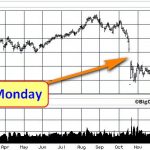
30 years ago, the stock market “crashed” on a single day. It was called Black Monday. At the time, I was in high school. I put aside the newspaper from that day thinking it would be a major collectors item in years to come. It hasn’t, but not because it wasn’t a big event. Black Monday was the name given to the biggest one day drop in the stock market. On October 19, 1987, the Dow Jones Industrial Average plunged 22.6% in one day. Back then, the Dow was still everything. The NASDAQ was the stock market where also-ran stocks that couldn’t qualify for the NYSE traded. The S&P 500 was known to savvy investors, but your average American still didn’t know much about the stock market beyond what showed up in 45 seconds on the nightly newscast. In fact, many of them didn’t own any stocks, unless they had a 401k account at work. Online trading was still in the future, and discount brokers took orders on the telephone. Unlike previous crashes, Black Monday did not start a panic. It did not lead to a depression. The drop was serious, and real. For the rest of 1987, the market …

Read More

Fix RMD Tax Problems With QCD

irs taxes tax form

You’ve spent a lifetime saving for retirement, and you did a really great job. So great, in fact, that you don’t need to take money out of your IRAs. But, you’ve turned 70 1/2, and now the IRS is forcing you to withdraw money from your IRA every year in the form of a Required Minimum Distribution, or RMD. Is there any way to get around having to take an RMD? Mitigating Your RMD’s Affect On Your Taxes The IRS gave you years of tax relief on the funds in your IRA. They only did that to encourage you to save for retirement. Now, that you’re retired (or at least retirement aged) they want their money now in the form of taxes on your IRA withdrawals, but if you played your cards right, you might not ever need to withdraw, and the IRS would have to wait longer for that money. The IRS hates waiting.Ā  The RMD keeps this from being the case. Once you turn 70 1/2 years old, you have to take some money out every year, and the government is there, waiting to tax it. Unfortunately, there is no way to get out of having to take …

Read More

Return of High Risk Mortgages

There was a recent article over at CNBC about high-risk mortgages and their resurgence, sometimes at the hands of the very same players who offered them before the big banking crisis and subsequent recession of 07-08. Of course, it’s easy to wring your hands and worry, “Here we go again,” but before you do that, take a closer look. High-Risk Mortgages Are Not “Bad” There is nothing wrong with a high-risk mortgage. Just like a no credit credit card, a high-risk mortgage has a greater chance of defaulting than one given to lower risk borrowers. However, that isn’t inherently a bad thing. On a macro level, the credit markets work a lot like the insurance markets. Take life insurance, for example. Some people are going to die, and you are going to pay out on those policies. However, as long as the premiums you take inĀ from everyone exceed the amounts you pay out, the company profits. Everybody wins. Similarly, with high-risk home mortgages, you know some people are going to default. Again, as long as your portfolio of mortgages collects more payments than you lose through defaults, you win. This is how the entire bond market works. Risk is fine, …

Read More