Tender Offer ADT Shares
tender offer adt

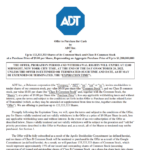
I still have to write up my big Webull review (it goes along with my Public, Wealthfront, Robinhood reviews), but suffice to say that during my test of Webull I was granted one share of ADT Inc. stock as part of my “You may receive one share of any stock up to Apple and Microsoft and really awesome stocks that you want to own… <in fine print> or a sucky one valued at at least $4.” Hey, free is free, right? So, it was with some confusion that I received a Time Critical – Must Respond letter from Webull Financial LLC in which they gave me no idea whatsoever what was going on, or why it was time critical. Since this is still Web 2.0, or whatever, they did provide a website where I could take one number from the top of the letter–and after some searching–a number from the bottom of the letter to log into what my wonderous offer might be. A Tender Offer The reason they sent me a letter is because I own shares (one share) of ADT stock. This is technically a tender offer under which I can sell my ADT stock for $9. On …


Read More

Did Americans Really Lose $900 Billion in The Recession

americans losing money

Anyone who has been online for more than a day or two knows that the way to get clicks is to have a big, shouting, headline. One popular search engine optimization (SEO) plugin won’t give your title a passing score until it has “a positive or negative sentiment.” Ideally, it also contains a number and a “power word.” Is it any wonder then that financial news headlines scream things like, “Americans Have Lost $900 Billion Since…” or “America’s Richest Tech Billionaires Have Lost $315 Billion In the Past Year?” How Do You Actually Lose Money When the Stock Market Crashes? Let’s talk about investing and losing money. First, we are going to talk about net worth and how much equity you have in your home. It’s for a good reason, I promise. Your net worth is the value of all of your assets minus all of your liabilities. The key word there is all. If your car is worth $15,000 and you owe $8,000 that counts as $9,000 of your net worth. Even that ping pong table in the basement that is worth $50 counts towards your net worth. As you can imagine, this goes off the rails quickly. The …

Read More

Jeremy Grantham Calls S&P 500 Down 26%

Jeremy Grantham Calls S&P 500 Down 26% 1

I don’t mean to pick on Jeremy Grantham, I was asked to write something once in my role as a professional financial writer and it got his name stuck in my head. So, whenever I see Mr. Grantham’s name scrolls by on my market news feed, I just have to take a look. I’ve written about Jeremy Grantham prediction history before. Some of Grantham’s calls were great, and everyone seems to remember, but also about the calls that were flat wrong, early, or just money losing. No one seems to remember those. So, let’s do the honorable thing. Let’s see how Jeremy Grantham’s predictions work out this time. Jeremy Grantham Stock Market Prediction Let’s get the details right. On September 8, 2022, Jeremy Grantham told the Reuters Global Markets Forum (GMF) that the S&P 500 could be trading at 3,000 in a year from now. On Wednesday, the S&P 500 index traded from around 3,900 in the morning, to around 3,997 in the afternoon, so we’ll call it 3900ish. If on September 8, 2023, the S&P 500 is trading around 3,000, we can say he is “right” this time. Of course, Grantham called a crash in 2019. He called an …

Read More

How 1% Tax on Stock Buybacks Affects You

How 1% Tax on Stock Buybacks Affects You 2

The Inflation Reduction Act has a lot of new features. One of the one that I keep hearing about is the new 1 percent tax on share buybacks and how that will affect investors. The 1% Share Buyback Tax Means Nothing There is a lot of noise around companies buying back their own stock after many (most?) companies acted irresponsibly with the money they earned, or were granted, during the pandemic by buying back their shares and then laying off people because they didn’t have enough money. It is no secret that I disapprove of companies buying their own stock. The practice is supposedly a way to return money to shareholders, but it is a very poor way of doing that. To make matters worse, most companies just turn around and reissue those shares in the form of executive stock option bonuses. It doesn’t take a Nobel Prize winning economist to see that share buybacks benefit company executives far more than they do shareholders. Take a look at the companies that have spent the last few years or decade buying back stocks and see if they performed any better than their competitors over the same time period. A majority of …

Read More

Welcome to Rule 8

rule 8 of investing

No rules about the stock market are 100% valid. In fact, a great many rules and sayings are flat out false, but there is just enough to juice in a few of them to keep, and just enough fund in a few others to keep them around. There’s the Santa Claus Rally, and Sell in May and Go Away, among others. Bob Farrell’s 10 Rules for Investing One of the rules, or set of rules, which keeps floating around due to both their perceived truth, and the fact that several of them are either obvious or broad enough to mostly always be true are Bob Farrell’s 10 Rules for Investing. Bob Farrell’s 10 Rules for Investing are time tested, even if not 100% correct. The most interesting of all Bob Farrell’s ten rules right now is number eight. Bob Farrell’s #8 Rule for Investing: Bear markets have three stages – sharp down, reflexive rebound, and a drawn-out fundamental downtrend. Depending on how you want to look at your bear market, could this be considered the reflexive rebound? It’s actually trickier than it sounds because, unlike what it might feel like, the market has not come straight down. There have been …

Read More

What Determines a Bear Market

Technically speaking, the stock market is already in a “correction.” A correction is defined as a drop of more than 10%. So, what qualifies as a bear market? What is meant by a bear market, and perhaps most importantly of all, is this a bear market? What Constitutes a Bear Market? Just like a correction is defined as a drop of 10% or more in the stock market, a bull market is defined as a drop of 20% in the markets. How do you measure for a bear market? First you have to pick an index, or other indicator for your measuring. A popular one is the S&P 500. Then, you calculate from the tippy top of your market indicator, and when it gets 20% lower than that, then you can call a bear market. Technically, there should also be widespread negative sentiment, and some of that stuff, but a financial website writer on a deadline likes hard numbers. So, according to the folks over at MarketWatch, we will be in a bear market if the S&P 500 closes below 3.837.25, then we have ourselves a bear market. Obviously, if this is a real bear market, it will do more …

Read More

S&P 500 Hits 52-Week Low

sp500 52 week lows

Now, things are getting interesting. There is a new SP500 52-week low. I’ve spent most of the first part of this year making the argument that the 2021 stock market run, especially the October 21 to January 22 was overdone and that the corresponding downturn in the markets from around February 2022 to April 2022 could be considered more of a return to “normal” than any sort of market correction. Reasonable minds may differ. Market Downturn Gets Real Today, the S&P 500 took out its 52-week low. From here on out, everything down, is truly down. Our one big sideways stock market ends here, and we really are heading for a potential correction here. This is why people calling for the Fed to raise interest rates so fast are dead wrong. The signs of the economy slowing, but not declining, are everywhere. That is exactly where you want to be. That is what a soft landing is. An economy gliding back to normal growth, normal employment, and normal interest rates all without triggering layoffs, housing crashes, and so on. All the Fed needs here is a little tap on the brakes. If it were me, I would skip a rate …

Read More

Finance Press Headlines

stock market headlines

Oh, the financial press loves their dramatic headlines. Sometimes in order to make the stock market more interesting, you have to give people a little bit of whiplash. Whew! What a difference a day makes. Yesterday, it was the “best day in 7 weeks.” Today, it’s the “worst month since 2008.” Overall, the market is still moving sideways, although we are getting a bit of a drift down and things might change especially as the Fed raises interest rates to cool off inflation. Remember, inflation cools off when the economy cools off. That’s the dance. Go too far to stop inflation and you can push the economy into a recession.

Stock Market Melt Up

stock market melt up

Oh, goodie. It’s time for some more stock market terminology. What Is a Melt Up? The world of finance, like any specialized group, has numerous terms, acronyms, and phrases that apply to managing money and investing in the stock market. Things like “Santa Claus Rally” are less about being able to describe something, and more about having fun, sometimes clever, ways to describing events, strategies, and happenings that occur. Santa Claus Rally — The somewhat common phenomenon of the stock market rising into the end of the year. Today’s word of the day comes courtesy of CNN Finance and Luke Lango, InvestorPlace senior investment analyst who wrote that they believe there will be a massive melt up over the next two years in which the stock market would rise 20% or more before tipping over into a recession or crash. I haven’t had a chance to look into Luke Lango’s track record. Maybe I’ll do that when I finish writing my freelance finance writer projects. Should We Worry About a Melt Up? Good news, investors. As always, the best way to invest for long-term goals is with a well-diversified portfolio tailored to your goals and risk tolerance. Such a portfolio …

Read More

Stock Market Trading Sideways

nothing to see here

Update: It’s been 15 days of breathless up and down headlines from the financial media since I first wrote this article, and the stock market is STILL trading sideways. Take a look at three months of the Dow. The stock market often trades “sideways” as it consolidates after moves up or down. This is very common after big run-ups or drops, as well as when the economy is sort of waiting to see what happens. Of course, the stock market doesn’t literally trade sideways with the S&P 500 chart moving to the right as some sort of straight line. Instead, the market goes up and down, sometimes daily, sometimes over a period of a few days, all with the eventually outcome of having not moved up or down much at all. However, that doesn’t make for a clickable headline for financial reporters and financial news sites. So instead, we see things like this from Marketwatch. U.S. stocks fell Tuesday, with the Nasdaq Composite leading the way down after the previous session’s technology sector gains, as investors kept a close eye on plans for more sanctions on Russia and remarks by Federal Reserve policy makers. Nasdaq leads stocks lower as investors …

Read More