Still waiting for that market implosion everyone was certain was going to happen a few months ago?
Looks like you’ll have to wait a little longer.
I usually have to wait a little more to pull out the “I told you so,” on the stock market being a constant swirl of ups and downs that should be ignored by long-term investors. Long-term investors, of course, should be sticking to their long-term plans and only making adjustments to rebalance their portfolios. This is often easier said than done.
Usually, in the middle of a down period, people start showing up or calling to tell me that they were, “right,” and that they pulled all of their money out of the stock market and now they weren’t losing anymore money and I am dumb for saying they would be better in the long run if they had just stayed put. They never call me to tell me they put their money back in right before things start going up, but that’s another matter *eyeroll*.
This super, mega, down, recession is coming, batten down the hatches, plunge was too short for that to happen this time.
Market Back To January 1 Levels
Right after the new year, a confluence of events sent the market down in a pretty convincing slide. At the time, I reminded readers here that long-term doesn’t mean two months, and that the market had just finished a virtually nothing but up run and that a little pause here was probably a good thing. It seems that market volatility is something that occurs often enough now that no one piped to explain that this time was different. (Pro Tip: It’s never different this time either.)
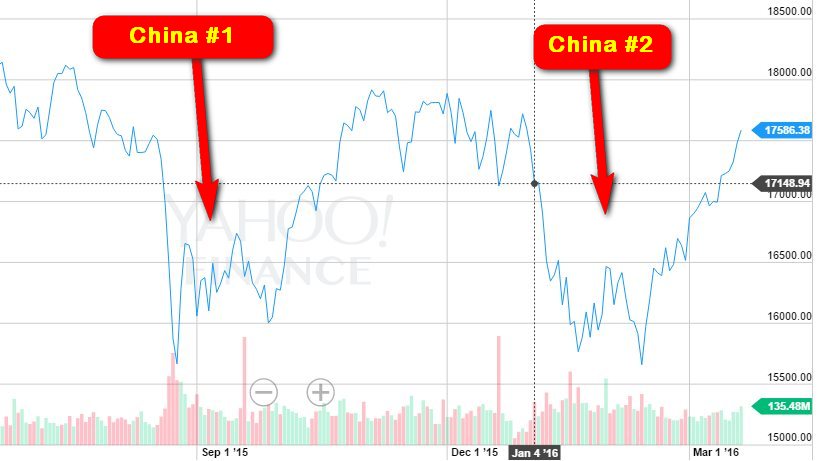
If you haven’t been paying attention, you might not have noticed that the stock market, or more specifically, the Dow Jones Industrial Average has worked its way back up to where it was on the first trading day of the year, January 4th. That still is off from the highs of May, but as we’ve discussed, those highs were probably too high to begin with.
In fact, if you want to take a look at a one-year chart, you’ll see that last year’s China crash (mini-crash?) looks pretty much exactly like this year’s China crash. Will there be another one? It’s hard to say.
What we can say is this. The U.S. economy looks better than it has in a while. Unemployment is down but inflation is non existent. Construction is way up by the looks of things around the Denver area, which means that cheap interest rates are finally starting to work. The Fed will need to keep an eye on inflation, but with, now two, rate increases pretty much already dialed in for 2016, the breaks are all set to be tapped. (The Fed stepped back from it’s predicted 4 rate increases yesterday.)
In other words, economy wise, things are looking good. However, remember that the stock market is a leading indicator (it attempts to price the future value of companies) so it should/could/would turn before the economy itself does. However, if things keep moving forward, we might see some actual economic growth for the next few years.
Crystal Ball Guessing – Warning
I am not a professional analyst. I am not a professional financial planner. This information is for educational purposes only. Any investments bought or sold should be done so based on your own research and analysis.
I can’t help but pull out the crystal ball here. So far, everything has gone pretty text book in the recovery from the Great Recession, albeit slower than is typical. However, where we sit now, we should be, if the textbook keeps going, look forward to a few years of solid growth before the next bubble (any guess where that might be?). There are risks, of course, but we’ve weathered the downfall of Japan, we can weather the downfall of China, if it is truly happening (now or later). Europe is a bit of a mess, but it no longer looks like a ‘taking down the world markets’ type of mess.
If you have a long time frame, and have not panicked at any time during the last two mini-crashes, it may be time to recheck your portfolio allocations. Maybe if you have some side money like in an Acorns app account, it might be worth seeing if you feel like getting more aggressive on a small part of your money.
Oh, and take another look at those bond funds too…