Trump’s Trade War

china trade war imports

Donald Trump launched a trade war –on purpose– by attaching large American import tariffs on steel and aluminum. These tariffs might have worked a decade or two ago, when both Republican and Democratic administrations were happy to watch American manufacturing gallop out of the country to cheaper producers, but these days, there aren’t many American steel mills and aluminum plants to protect. Still, based on Trump’s limited understanding of the economy and global trade, the tariffs make sense because American producers have been harmed by noncompetitive government subsides and subsequent dumping. Lost on Trump is that his own companies used cheaper, imported Chinese steel in most of his buildings. Trade Wars Have Casualties Trump’s oft cited target for unfair trade practices is China, although the steel and aluminum tariffs are hardly surgical strikes against the Chinese, impacting numerous other countries as well, including America’s trade, strategic, and global allies. Nonetheless, as far as Trump understands the economy these industries represent real, American manufacturing lost to “cheating” foreign competitors. When presented with the possibility of retaliation, Trump and his flunkies suggest that America can win any trade war. This is 100% true. No country can defeat America in a trade war IF the country …

Read More

401k Fiduciary Rule

401k fees savings fiduciary

Politics sometimes makes it hard to get straight information about important topics relating to your finances. In this case, a court has struck down an Obama era rule that essentially applied the fiduciary standard to certain 401k advisors. According to the Republicans, this is a giant victory for freedom, and business, and enterprise. According to Democrats, this is a giant blow to fairness, and an attack on all hard-working Americans. As is so often the case when politicians get involved, the reality lies somewhere in between. What Is Fiduciary Standard? There is a HUGE amount of case law and statutes about what exactly makes up fiduciary standards, but for our purposes, the easiest way to understand is to compare to the other existing financial standard, suitability. I spend several years as a financial advisor. During that time, I was under the suitability standard. This meant that investments I recommended had to be suitable for my clients. In other words, I wasn’t supposed to be recommending highly-volatile, high-risk, futures contracts to my widowed, orphaned, school teacher, clients. Practically speaking, this standard had a lot less to do with what I wanted to recommend, and a lot more to do with what my company …

Read More

Is Inflation Real Finally?

The Fed has been raising interest rates over the last few years based on fears of inflation that never seemed to come to pass. But, with monetary policy still very loose, and investors in a good mood pushing the stock market higher and higher (with a few days of correction last week), the rising rates seemed to have no real effect on the economy. Unfortunately, this is the way economic policy works. Nothing happens, until it does, and then you have to hope that you already got it right. Inflation in January The 12-month rate for wholesale inflation rose to 2.7% for January. That’s a pretty big number, and it’s the first one that actually suggests the Fed’s long feared inflation might actually be real. Before the data came out, the markets (and the Federal Reserve’s dot plot) anticipated three rates hikes in 2018. The current rate is 1.5%, and assuming the Fed follows it’s recent history by raising rates a quarter-percent (0.25%) each time, that means that interest rates would end the year at 2.25%. That’s hardly high, historically speaking, but definately higher than anything this market has seen in a long time. Add-in the fact that the Fed …

Read More

Stock Market Correction

After Monday’s stock market fall, there was a run up yesterday on Tuesday, then a little drop on Wednesday, and now a 1000+ point market drop again today. So, let’s get a headcount before we proceed. Stock Market Results Last Few Days Monday: -1175 Tuesday: +567 Wednesday: -19 Thursday: -1033 Add it all up, and you get -1,660 for the week. Oh, and by the way, the market was down 666 points last Friday. From the market’s high point, this equates to a drop of a little over 10% putting us into correction territory. (A correction is usually defined as a drop of 10%.) Do We Panic Now? Take a look at what I wrote about Monday’s big stock market drop. Although the market has dipped even further, the result remains the same. For long-term investors with a well diversified portfolio, the best course of action is to ignore all short-term market moves. Even if this is the beginning of a recession (We are totally due for one) the long-term scenario is still the same. The ever higher march of inflation, plus a U.S. economy that always comes back eventually means that holding on, and continuing to invest is the best solution for long-term investing …

Read More

Stock Market Plunges – Shall We Panic?

2018 crash stock market

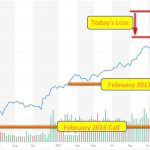
The Dow Jones Industrial Average fell almost 1,200 points. The headlines scream “Largest 1-Day Point Drop in History.” — They say “point drop,” because as a percentage, this declines isn’t even close to the worst. As the Dow increases in value, the percentage of a point becomes a smaller number. This 1,200 points is equal to 4.6%. That’s nothing to sneeze at, but it is not anywhere near as bad on a percentage basis as the 508 point Black Monday crash, which at the time was a drop of 22%. (Could a Black Monday type crash happen again?) Perspective is fun! The 2018 Crash Before we decide to panic, let’s look into our crystal ball and see what will happen in the next few days. First, don’t expect any of the politicians who were taking credit for the stock market rising to come out and accept any blame for the market falling, even though, if one is true, the other must be true as well. The reality is that politicians are never responsible for short-term market moves, no matter how much they try and take the credit. So, this crash isn’t their fault, but the runup wasn’t to their credit …

Read More

Disney Buys Fox Assets With Stock

disney merger fox

Well, this is a big deal on the merger front. Disney is buying a bunch of 21st Century Fox’s media assets. Now, before you start in with your political conspiracies, the deal is to buy the movie and TV studio businesses, not stuff like Fox News. All Stock Deal What makes this deal a little crazy is that according to reports it is for $52.4 billion, but it is an all stock offering. It also comes with Disney assuming $13.7 billion in debt. That makes the cost to Disney for this takeover astronomical, but again, it’s all on paper. The purpose of the deal seems to be let 86-year old Rupert Murdoch sort of retire. He’s built up this empire over the years, but running a big company takes a lot of commitment, and these days, Murdoch seems to care less about movies and entertainment than he does about politics. More specifically, by selling, Murdoch is cashing in his empire for billions of stock in a major U.S. company. This no doubt more about estate planning for Murdoch, than any expectation for the future of the companies. Leaving a giant company to an heir is always a bit risky, and …

Read More

December Rate Hike (Again)

interest rates federal reserve

The Fed has now completely given up the pretense that it’s interest rate increases have anything to do with its 2% inflation target. Now, it is about tightening up the financial conditions, and in particular trying to put the breaks on the stock market. As noted over at Market Watch Reinhart said current policy is not dissimilar to the steady quarter-point rate hikes seen from 2004-2006. The only thing missing is the phrase “measured pace,” he said. Beginning in the summer of 2004, the Fed raised its short-term rate target from 1.25% to 5.25% in 17 straight quarter-point moves. But the policy failed to trigger tighter financial conditions, Harris noted. And, this is what should be terrifying. From 2004 to 2006, the Fed insisted on raising rates right into what would become the Great Recession. By raising rates when there is no inflation, the Fed becomes a really powerful group of market timers who have decided the stock market (this time, the real estate market last time) is “too high.” Ironically, this all becomes a self-fulfilling prophecy. When the Fed’s interest rate hikes finally do get the attention of Wall Street, it comes in the form of a knife slashing …

Read More

Is Slack a Good Investment

Is Slack a Good Investment 1

Got some questions about the (semi) big news about Slack getting a new investment. The catchy headlines say that Slack is “now worth over $5 billion”. Of course, with snazzy numbers like that, more than a few readers are wondering if investing in a Slack IPO is a good move. How Much Is Slack Really Worth? First off, let’s back up and do a reality check. Slack is not “worth” $5 billion now. It’s latest funding gives it a valuation of $5 billion, but that isn’t the same thing. Example time! Let’s say I have a company. We’ll use my freelance writing business of ArcticLlama. Now, I don’t have any funding, but if I did, it would work something like this. An investor offers me $1 million for 10% of ArcticLlama. I say yes. So, if the 10% of the company is worth $1 million, then mathematically, the whole company is worth $10 million. That is what a valuation is. This does not mean anyone would actually give me $10 million for the company, just like there isn’t likely anyone out there willing to pay $5 billion for Slack right now either. This is kind of a game, and it’s …

Read More

Return of High Risk Mortgages

There was a recent article over at CNBC about high-risk mortgages and their resurgence, sometimes at the hands of the very same players who offered them before the big banking crisis and subsequent recession of 07-08. Of course, it’s easy to wring your hands and worry, “Here we go again,” but before you do that, take a closer look. High-Risk Mortgages Are Not “Bad” There is nothing wrong with a high-risk mortgage. Just like a no credit credit card, a high-risk mortgage has a greater chance of defaulting than one given to lower risk borrowers. However, that isn’t inherently a bad thing. On a macro level, the credit markets work a lot like the insurance markets. Take life insurance, for example. Some people are going to die, and you are going to pay out on those policies. However, as long as the premiums you take in from everyone exceed the amounts you pay out, the company profits. Everybody wins. Similarly, with high-risk home mortgages, you know some people are going to default. Again, as long as your portfolio of mortgages collects more payments than you lose through defaults, you win. This is how the entire bond market works. Risk is fine, …

Read More

Economy Slowing Down?

Only have time for a quick and dirty update, so here goes. It may not be the most accurate of headlines, but there were a couple of interesting numbers out today, especially when it comes to the hawks and doves inflation battle, so I thought it would be fun to take a break from all of the doomsday articles about the stock market. Still No Inflationary Pressure It seems that inflation is falling (not rising), countering the theory that such a drop in inflation earlier this year was only temporary. Oh, and jobless claims are up. In other words, the inflationary pressures are still not there. All of this adds up to a Federal Reserve that might just be figuring out that there is no need to raise interest rates any more this year. (And the previous increase was probably unnecessary as well.) This goes double if geopolitical trouble (Trump v North Korea) spooks business and investors. It may turn out that this global instability is just the pinprick the stock market needs to head back down for a correction. If so, remember that it wasn’t any stock chart, or Shiller PE ratio, or super-duper analyst investigation that said it …

Read More